Abstract
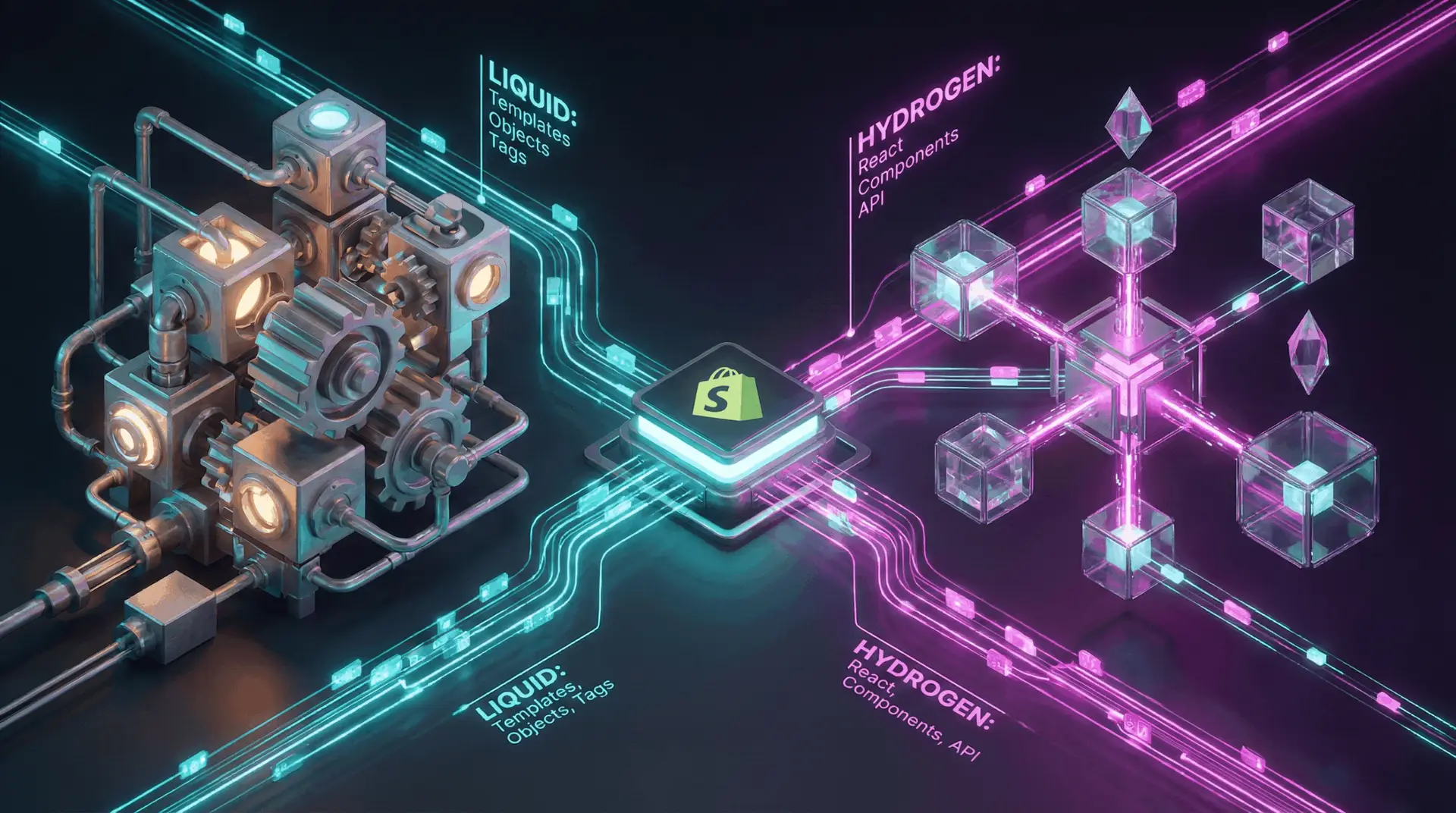
The architectural schism in the Shopify ecosystem has widened into two distinct, viable paths for enterprise merchants: the monolithic robustness of Liquid themes and the composable agility of Hydrogen. As of 2025, the decision between these technologies is no longer merely about “headless” versus “traditional”; it is a calculation of Total Cost of Ownership (TCO), performance scalability, and the organizational maturity of engineering teams. This analysis deconstructs the technical realities of both frameworks, offering a definitive guide for technical leaders navigating the 2025 e-commerce landscape.
The Evolution of the Storefront Architecture
For over a decade, Liquid has served as the bedrock of Shopify’s frontend experience. As a server-side templating language written in Ruby, it acts as a direct bridge between the database and the HTML rendered in the browser.1 Its tight coupling with the Shopify platform ensures that data availability is immediate and server-side rendering (SSR) is the default behavior. However, the monolithic nature of Liquid themes has historically imposed a performance ceiling, particularly for brands integrating heavy third-party applications that inject synchronous JavaScript, leading to degradation in Core Web Vitals such as Interaction to Next Paint (INP).
In contrast, Hydrogen represents Shopify’s standardized answer to the headless commerce demand. Built on React and Remix, Hydrogen leverages React Server Components (RSC) and streaming SSR to decouple the frontend from the backend entirely.4 This separation allows for “optimistic UI” updates—where the interface reflects a user’s action (like adding an item to the cart) before the server confirms it—creating a perceived latency of zero.5 By 2025, this framework has matured from an experimental alternative to the preferred stack for high-velocity DTC brands requiring bespoke user experiences that Liquid cannot support.
Technical Deep Dive: Liquid in 2025
Liquid remains a formidable choice for merchants who prioritize stability and low maintenance. The “Online Store 2.0” architecture introduced JSON templates, allowing for section-based modularity that mimics component-based design without the overhead of a JavaScript framework.
The Performance Argument for Liquid:
Contrary to the belief that “headless is always faster,” a well-optimized Liquid theme can outperform a poorly architected headless site. Liquid’s server-side rendering is highly optimized by Shopify’s infrastructure. The platform handles caching, asset delivery, and database queries at a deeper level than is accessible to external frameworks. For merchants with standard catalogs and minimal need for complex, app-like interactivity, Liquid offers the shortest path to a performant storefront.
However, the limitation lies in state management. Liquid is stateless; managing complex user sessions or dynamic, client-side data updates (such as a multi-step quiz or a 3D product configurator) often requires “spaghetti code” involving jQuery or vanilla JavaScript, which becomes unmaintainable at scale.
Technical Deep Dive: Hydrogen & Remix
Hydrogen changes the paradigm by utilizing Nested Routing, a core feature of Remix. In a traditional Single Page Application (SPA), data fetching often results in a “waterfall,” where a parent component must load before its children can fetch their data. Hydrogen’s router loads data for all nested route segments in parallel, eliminating these waterfalls and significantly reducing Time to Interactive (TTI).
The Streaming SSR Advantage:
Hydrogen utilizes streaming Server-Side Rendering. Instead of waiting for the entire page to be generated on the server before sending any HTML to the client (a bottleneck in traditional SSR), Hydrogen streams the HTML as it is generated. The browser can begin rendering the layout while the product data is still being fetched, perceived by the user as an instant load.
SEO Implications:
Early headless implementations often struggled with SEO due to Client-Side Rendering (CSR). Hydrogen avoids this by ensuring that search engine crawlers receive fully populated HTML document object models (DOMs), parity-matched with the capabilities of Liquid but with the dynamic flexibility of React.
Decision Matrix: The TCO Calculation
The choice between Liquid and Hydrogen in 2025 is rarely purely technical; it is economic.
| Feature | Liquid (Monolithic) | Hydrogen (Headless) |
| Development Velocity | High (Templated) | Medium (Custom Code) |
| Engineering Requirement | HTML/CSS/Liquid | React/TypeScript/GraphQL |
| Maintenance Cost | Low (Shopify Managed) | High (Owner Managed) |
| Third-Party Integrations | Plug-and-Play (App Store) | API-Based (Custom Integration) |
| Performance Floor | Good | Variable (Code Dependent) |
| Performance Ceiling | High | Extremely High |
For a brand generating under $10M GMV, the overhead of maintaining a Hydrogen storefront—which often requires a dedicated React engineering team—may outweigh the performance benefits. Liquid allows these merchants to leverage the vast ecosystem of Shopify Apps which inject code automatically. In a Hydrogen environment, these apps often require custom API integrations, increasing the development burden significantly.
However, for enterprise brands, the flexibility of Hydrogen is non-negotiable. The ability to integrate a headless CMS (like Sanity or Contentful) directly into the React component tree allows for “editorial commerce,” where content and products are blended in ways impossible within the rigid structure of a Liquid theme.
Future Outlook
As we move through 2025, we observe a convergence. Shopify is introducing more “React-like” features to Liquid, while Hydrogen is gaining more “out-of-the-box” scaffolding to reduce setup time.1 The binary choice is softening, but the fundamental architecture remains: choose Liquid for speed and simplicity; choose Hydrogen for control and scale.