Abstract
Livewire 3 introduced Volt, a functional API that allows developers to write single-file components, bringing the developer experience (DX) of Vue/React Composition API to Laravel. This chapter explores the Volt syntax, comparing it to traditional class-based Livewire, and demonstrates how to build reactive, functional components that simplify the stack.
The Volt Paradigm
Traditional Livewire separates logic (PHP class) and view (Blade). While organized, this requires constant context switching. Volt allows defining logic directly inside the Blade file, enclosed in a PHP block.50 This “Single File Component” (SFC) approach drastically increases velocity for small-to-medium UI elements.
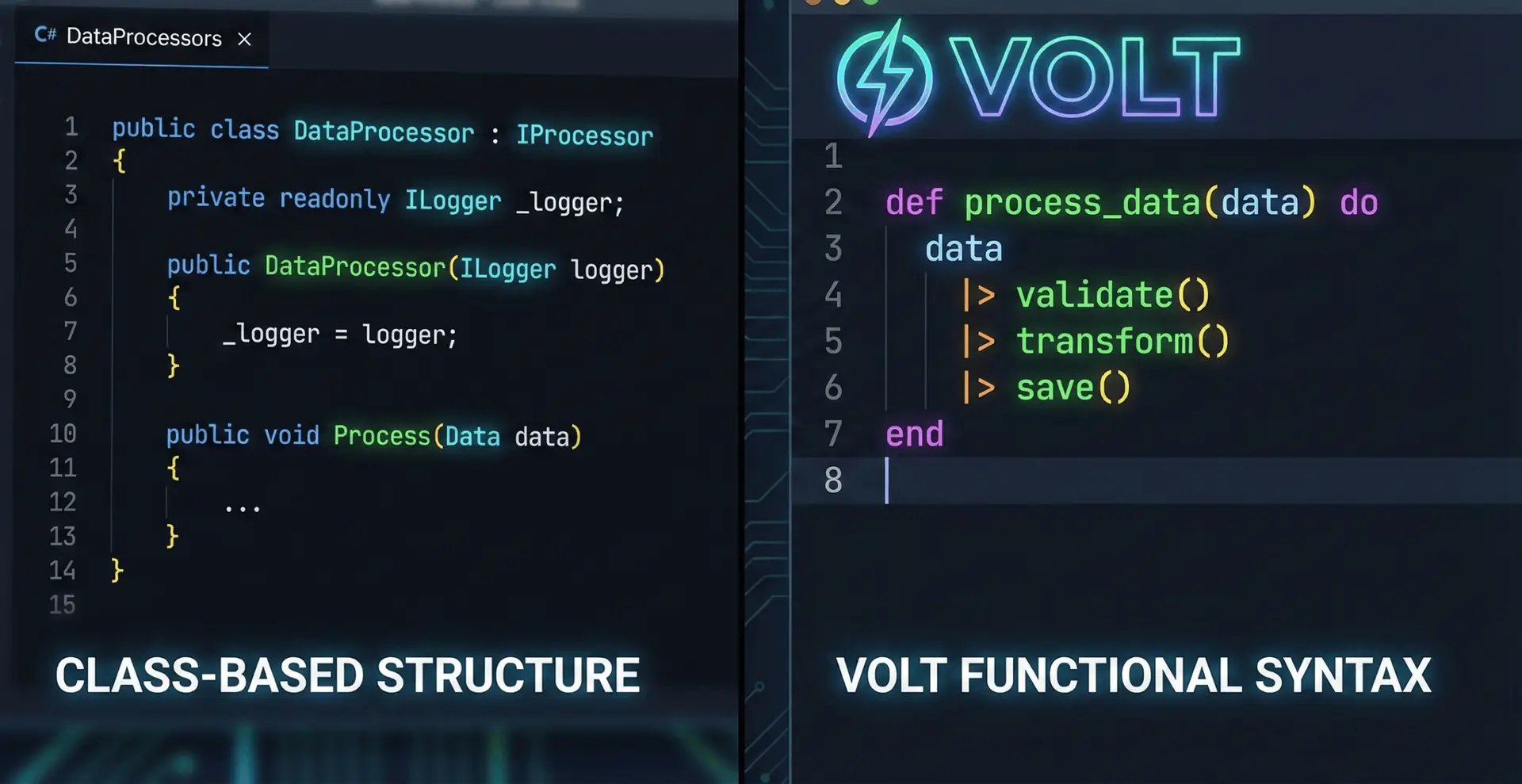
Functional Syntax vs. Class Syntax
Volt introduces the state function, analogous to useState in React.
Example: A Reactive Counter
<?php
use function Livewire\Volt\{state, computed};

// Define reactive state
state(['count' => 0]);

// Define an action
$increment = fn () => $this->count++;

// Define a computed property
$isPositive = computed(fn () => $this->count > 0);
?>

<div class="counter">
    <h1>Current: {{ $count }}</h1>

    @if($this->isPositive)
        <span class="badge">Positive!</span>
    @endif

    <button wire:click="increment">Add</button>
</div>
Everything—state, actions, and template—lives in resources/views/livewire/counter.blade.php.
Advanced Features
- Locked Properties: Security is paramount. You can mark a property as locked to prevent malicious users from tampering with it via the browser console (e.g., changing a User ID).
state(['userId' => 1])->locked();
- Mount Lifecycle: The mount hook allows for initialization logic, such as fetching data from the database when the component first loads.
mount(fn () => $this->count = Auth::user()->login_count);
- Modular imports: Volt supports “Partial Reloads” and lazy loading, making it highly performant for dashboard widgets that shouldn’t block the main page load.
Strategic Use of Volt
Volt is not a replacement for all class-based components. For complex components with heavy authorization logic, policy checks, or complex trait usage, the Class-based approach remains superior for readability. Volt excels at “leaf” components—modals, toggles, forms, and cards—where the logic is tightly coupled to the view.