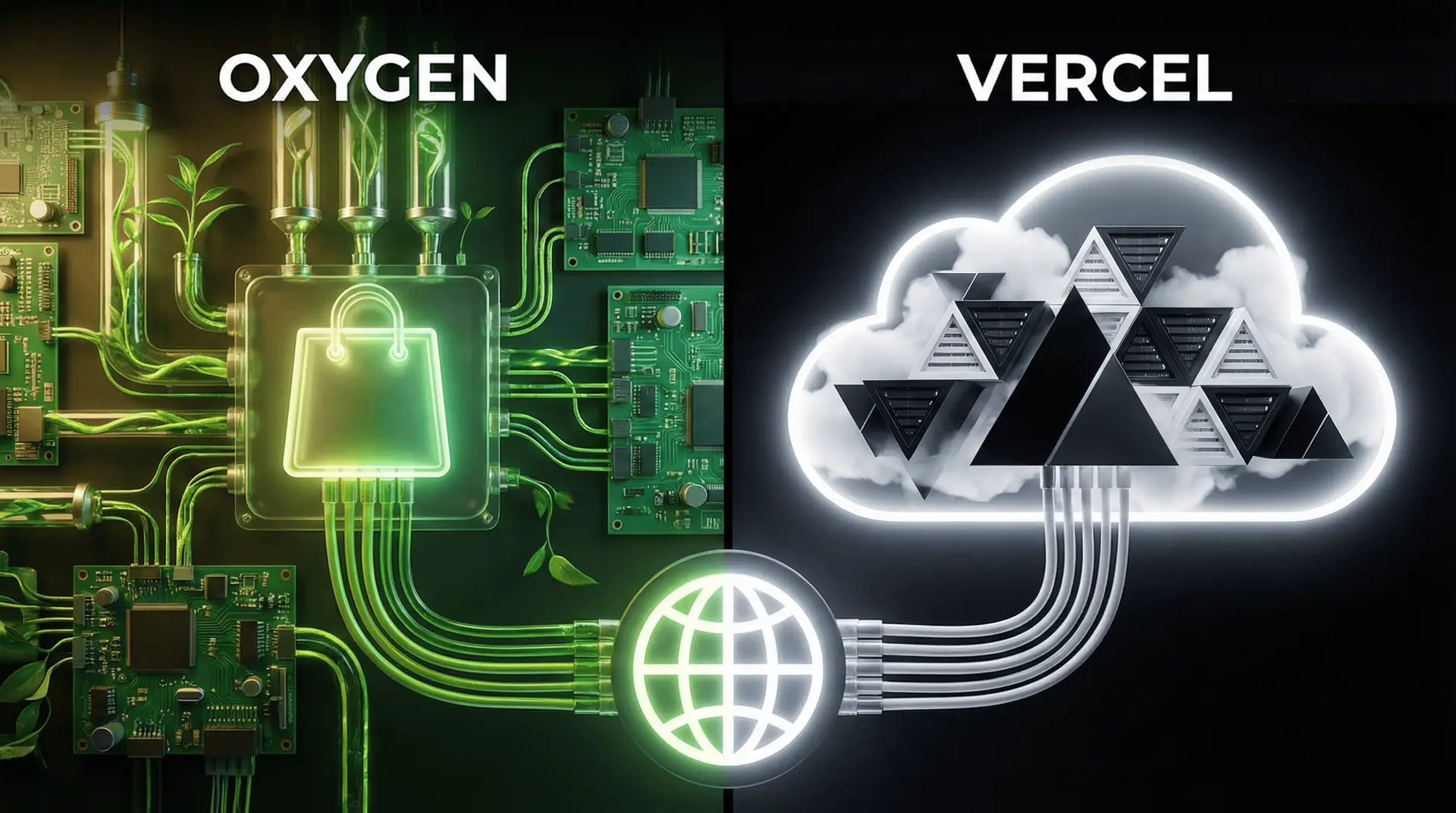
The decoupling of the frontend in a headless Shopify architecture introduces a critical infrastructure decision: where to host the storefront. In 2025, the market is dominated by two contenders: Shopify’s native Oxygen platform and Vercel, the industry standard for React deployments. This report analyzes the technical trade-offs, performance characteristics, and workflow implications of deploying Hydrogen storefronts on these competing edge networks.
Oxygen: The Integrated Edge
Oxygen is Shopify’s proprietary global edge hosting platform, engineered specifically for Hydrogen. Unlike generic cloud providers, Oxygen is aware of the Shopify ecosystem. It is “batteries-included,” meaning that a developer can deploy a Hydrogen storefront directly from the Shopify CLI without configuring external DNS, SSL certificates, or environment variable mappings—these are injected automatically based on the linked Shopify store.6
Worker Bundles and Global Distribution:
Oxygen deploys applications as Worker Bundles. When a deployment occurs, the code is distributed across Shopify’s global network of edge nodes. This ensures that the storefront logic executes as close to the user as possible, minimizing latency.6 This architecture mimics the Cloudflare Workers model but is tightly scoped to the commerce use case.
Cost and Operational Predictability:
A significant advantage of Oxygen is its economic model. It is included in Shopify plans (Basic through Plus), removing the unpredictable usage-based billing associated with serverless platforms like AWS or Vercel.3 For a high-traffic merchant, avoiding a separate invoice for bandwidth and compute hours can result in substantial TCO savings.
Limitations of the Walled Garden:
Oxygen’s integration is also its constraint. It supports only Hydrogen projects and enforces a specific directory structure. It does not easily support “Monorepo” architectures where a storefront might coexist with a backend middleware service or a design system library in the same repository.3 Furthermore, log retention is strictly limited (typically 72 hours), which forces engineering teams to pipe logs to external services like Datadog or Splunk for long-term observability.3
Vercel: The Composable Standard
Vercel represents the gold standard for React hosting. While Oxygen is optimized for Hydrogen, Vercel is optimized for the broader React ecosystem, particularly Next.js. However, Hydrogen (built on Remix) runs exceptionally well on Vercel’s edge network.
The Case for Heterogeneous Architectures:
Vercel shines when the storefront is just one component of a larger digital estate. If a merchant operates a main.com marketing site on Next.js, a blog on Gatsby, and a store on Hydrogen, Vercel can host all three under a single team account with unified CI/CD pipelines.8 This unification of the “Frontend Cloud” simplifies user management and deployment workflows across diverse technologies.
Middleware and Edge Function Granularity:
Vercel offers granular control over edge middleware that Oxygen currently lacks. Developers can write complex logic to intercept requests at the edge for A/B testing, geolocation-based redirects, or custom authentication gates before the request ever hits the Hydrogen application logic.6 Additionally, Vercel’s “Deployment Previews” feature—which generates a unique, shareable URL for every pull request—remains superior in its collaborative toolset (commenting, visual regression testing) compared to Oxygen’s preview environment.8
Performance Nuances:
While both platforms offer edge rendering, Vercel’s support for Incremental Static Regeneration (ISR) is a differentiator for merchants using Next.js. ISR allows pages to be static (fast) but updated in the background (dynamic). Hydrogen on Oxygen relies primarily on streaming SSR and caching directives. While streaming SSR is performant, ISR offers a different performance profile that some engineering teams prefer for content-heavy pages.7
Comparative Analysis Table
| Feature | Oxygen (Shopify) | Vercel (Independent) |
| Primary Framework | Hydrogen (Remix) | Next.js, Remix, Svelte, Vue |
| Cost Model | Included in Shopify Plan | Usage-Based (Bandwidth/Compute) |
| Setup Complexity | Zero-Config (Native) | Medium (Requires Integration) |
| CI/CD | Basic (GitHub Actions) | Advanced (Native Pipeline) |
| Edge Logic | Worker Bundles | Edge Middleware |
| Lock-in | High (Shopify Only) | Low (Portable) |
Strategic Recommendation
The choice between Oxygen and Vercel in 2025 is largely a reflection of the merchant’s architectural complexity.
- Pure Commerce Focus: If the goal is to launch a high-performance storefront with minimal DevOps overhead, Oxygen is the superior choice. The seamless integration with the Storefront API and the elimination of hosting costs make it the pragmatic winner for 90% of Hydrogen builds.8
Composable Enterprise: For organizations building a “Platform of Platforms”—integrating multiple microservices, distinct frontends, and requiring complex edge routing logic—Vercel provides the necessary tooling and flexibility, despite the additional cost.